BEGIN:VCALENDAR
VERSION:2.0
PRODID:-//Department of Philosophy//NONSGML Events//EN
CALSCALE:GREGORIAN
X-ORIGINAL-URL:https://philosophy.ubc.ca/events/event/
X-WR-CALDESC:Department of Philosophy - Events
BEGIN:VEVENT
UID:20251008T2231Z-1759962681.8235-EO-19667-19@10.19.146.24
STATUS:CONFIRMED
DTSTAMP:20260313T075931Z
CREATED:20241114T201031Z
LAST-MODIFIED:20241114T201537Z
DTSTART;TZID=America/Vancouver:20241206T150000
DTEND;TZID=America/Vancouver:20241206T170000
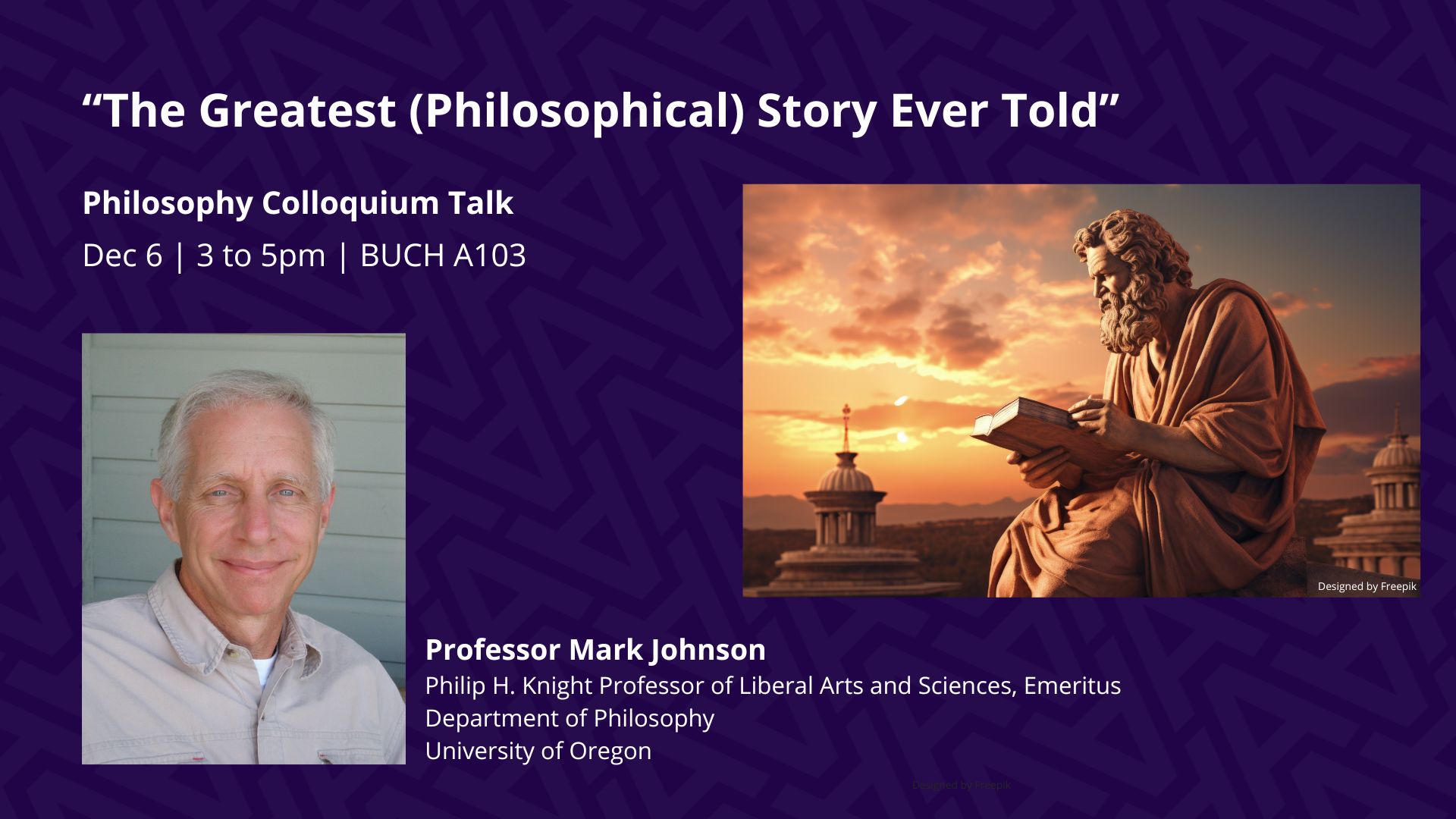
SUMMARY: Philosophy Colloquium – Prof. Mark Johnson: “The Greatest (Philoso
 phical) Story Ever Told”
DESCRIPTION: Title: “The Greatest (Philosophical) Story Ever Told” Abstract
 : John Dewey’s Experience and Nature (1925) is one of the greatest and most
  profound philosophical manifestos of all time. Why? Because he provides th
 e most exemplary model of how philosophy and the sciences can work together
  collaboratively to provide an empirically responsible conception of nature
  and our […]
X-ALT-DESC;FMTTYPE=text/html: <p><img class="alignnone wp-image-19669 size-
 full" src="https://phil.cms.arts.ubc.ca/wp-content/uploads/sites/19/2024/11
 /Colloquia-Dr.-Mark-Johnson.jpg" alt="" width="1920" height="1080" /></p><p
 ><strong>Title:<br /></strong><strong>“The Greatest (Philosophical) Story E
 ver Told”</strong></p><p><strong>Abstract:<br /></strong>John Dewey’s<em> E
 xperience and Nature</em> (1925) is one of the greatest and most profound p
 hilosophical manifestos of all time. Why? Because he provides the most exem
 plary model of how philosophy and the sciences can work together collaborat
 ively to provide an empirically responsible conception of nature and our hu
 man place within it. The result is a naturalistic\, non-reductive\, and plu
 ralistic view of mind\, meaning\, thought\, knowledge\, and values that are
  compatible with our present state of evolutionary development as well as w
 ith our individual development over the course of our lives. Dewey gives us
  a this-worldly account of how fallible\, finite human creatures experience
  meaning\, inquire intelligently into our problematic lives\, remake our ex
 perience for the better\, and find realistic values for the conduct of our 
 lives.</p><p><strong>Bio:<br /></strong>Mark Johnson is the Philip H. Knigh
 t Professor of Liberal Arts and Sciences\, Emeritus\, in the Department of 
 Philosophy at the University of Oregon. His research has focused on the phi
 losophical implications of the role of human embodiment in meaning\, concep
 tualization\, reasoning\, values\, and knowing\, especially from the perspe
 ctive of embodied cognition theory and pragmatist philosophy. His recent wo
 rk develops a naturalistic account of mind and knowing. He is best known as
  co-author\, with George Lakoff\, of <em>Metaphors We Live By</em> (1980) a
 nd <em>Philosophy in the Flesh</em> (1999)\, plus nine other books explorin
 g the bodily depths of meaning and imagination.</p>
CATEGORIES:Featured Events,Featured Homepage
LOCATION:BUCH A103
GEO:49.269076;-123.254727
URL;VALUE=URI:https://philosophy.ubc.ca/events/event/philosophy-colloquium-
 markjohnson/
ATTACH;FMTTYPE=image/jpeg:https://phil.cms.arts.ubc.ca/wp-content/uploads/sites/19/2024/11/Colloquia-Dr.-Mark-Johnson.jpg
END:VEVENT
BEGIN:VTIMEZONE
TZID:America/Vancouver
BEGIN:STANDARD
TZOFFSETFROM:-0700
TZOFFSETTO:-0800
DTSTART:20241103T090000
TZNAME:PST
END:STANDARD
END:VTIMEZONE
END:VCALENDAR
