BEGIN:VCALENDAR
VERSION:2.0
PRODID:-//Department of Philosophy//NONSGML Events//EN
CALSCALE:GREGORIAN
X-ORIGINAL-URL:https://philosophy.ubc.ca/events/event/
X-WR-CALDESC:Department of Philosophy - Events
BEGIN:VEVENT
UID:20250716T1429Z-1752676180.9367-EO-20279-19@10.19.146.22
STATUS:CONFIRMED
DTSTAMP:20250716T072940Z
CREATED:20250703T220647Z
LAST-MODIFIED:20250715T221812Z
DTSTART;TZID=America/Vancouver:20250905T150000
DTEND;TZID=America/Vancouver:20250905T170000
SUMMARY: Philosophy Colloquium – Prof. David Liebesman (University of Calga
ry) & Prof. Ofra Magidor (University of Oxford)
DESCRIPTION: Title: ‘Polysemy and Observations in Linguistics’ Abstract: In
linguistics it is standard to distinguish between two types of ambiguity:
homonymy\, where (roughly) a term has two completely unrelated senses (e.g.
‘ball’ as used for a spherical play object\, and ‘ball’ as used for a part
y)\; and polysemy\, where (roughly) a word has two closely related […]
X-ALT-DESC;FMTTYPE=text/html: 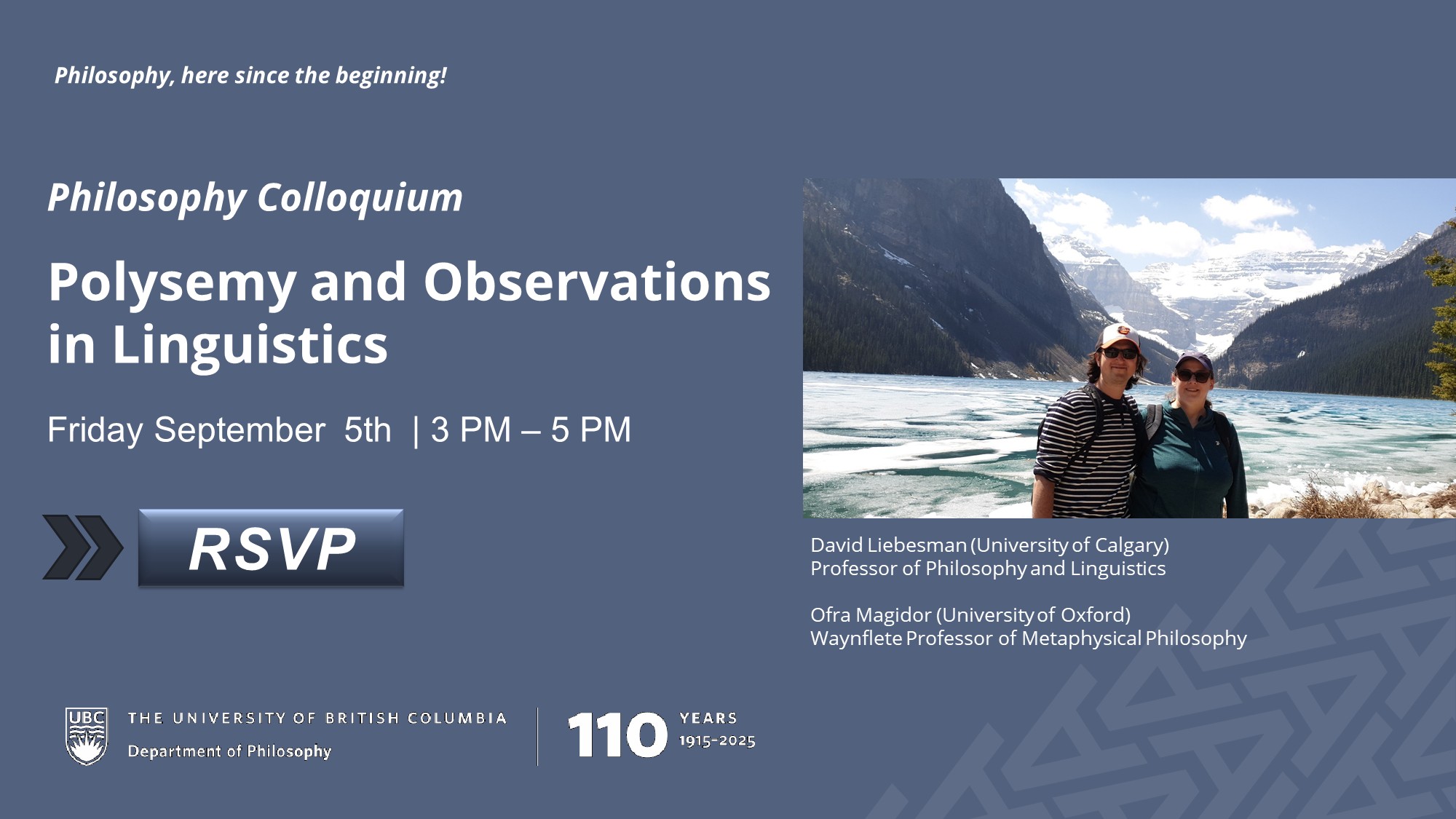
Title: ‘Polysemy and Observations in
Linguistics’
Abstract:
In linguistics
it is standard to distinguish between two types of ambiguity: homonymy\, w
here (roughly) a term has two completely unrelated senses (e.g. ‘ball’ as u
sed for a spherical play object\, and ‘ball’ as used for a party)\; and pol
ysemy\, where (roughly) a word has two closely related senses (e.g. ‘lunch’
as used for used for a an event taking place midday and for a portion of f
ood eaten at midday). The literature on polysemy reports a wide-range of al
leged observations regarding the concept based on both straightforward intu
itions of theorists\, as well as experimental data on wide-scale speaker ju
dgements and psychological processing.
In this talk\, we argue that m
any of these observations implicitly presuppose some theoretical assumption
s about the phenomenon of copredication (sentences such as ‘Lunch was delic
ious\, but took hours’). Indeed\, they implicitly rely on false theoretical
assumptions. After explaining what copredication is and our own preferred
theoretical account of the phenomenon\, we return to show how all this bear
s on the range of linguistic observations about polysemy.
Bio:
- David Liebesman\, Professor of Philosophy and
Linguistics at the University of Calgary
- Ofra Magidor\, Waynflete
Professor of Metaphysical Philosophy at the University of Oxford
ORGANIZER;CN="mau03":MAILTO:sophie.mc.au@ubc.ca
URL;VALUE=URI:https://philosophy.ubc.ca/events/event/philosophy-colloquium2
0250905/
ATTACH;FMTTYPE=image/jpeg:https://phil.cms.arts.ubc.ca/wp-content/uploads/sites/19/2025/07/PHIL_Colloquia20250905Web-1.jpg
END:VEVENT
BEGIN:VTIMEZONE
TZID:America/Vancouver
BEGIN:DAYLIGHT
TZOFFSETFROM:-0800
TZOFFSETTO:-0700
DTSTART:20250309T100000
TZNAME:PDT
END:DAYLIGHT
END:VTIMEZONE
END:VCALENDAR